


Objective
We plan to design an advanced testing facility that provides a representative environment for the development, rapid prototyping, deployment and validation of Guidance and Control (G&C) algorithms under realistic real-time operating conditions, with the ultimate goal of enhancing the computational efficiency, reliability, and accuracy of numerical methods. The corresponding facility, HYDRA will benefit from an extensive cooperation carried out with the Intelligent Control Systems Group that has a unique experience in the prototyping of the electric rockets that will be deployed in HYDRA.
Approach
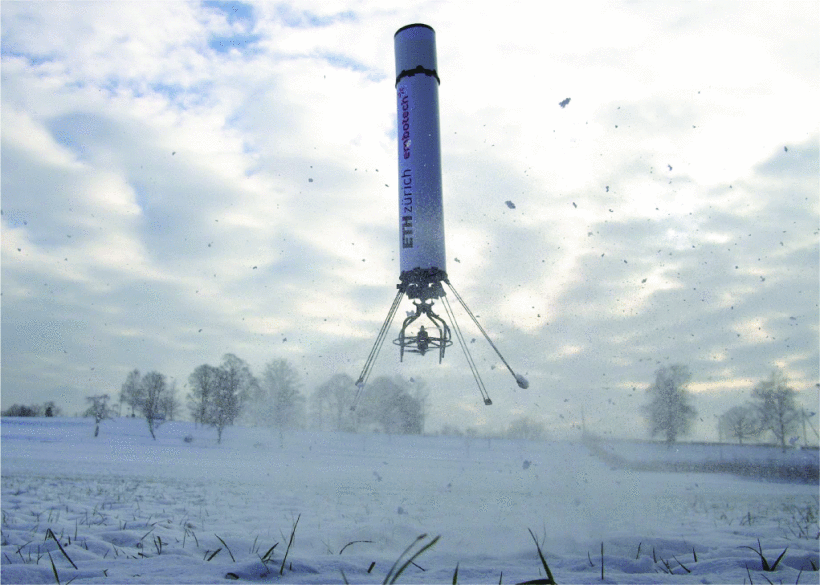
We pursue a step-by-step approach, where we first focus on a thorough Model-in-the-Loop development and implementation of high-fidelity numerical simulations that accurately reproduce the operational conditions of the testing facility. The simulation framework accounts for the physical constraints of the facility (e.g., the dimensions of the flight area), the limitations imposed by the selected hardware components, and a high-fidelity dynamic model of the flight system. Based on a model-in-the-loop architecture, the simulation captures the rocket’s physical characteristics and actuator limitations. Then, we move towards a Processor-in-the-Loop (PIL) and Hardware-in-the-Loop (HIL) validation before testing the algorithms on real systems in the lab. The primary hardware platform is the reusable electric-propelled rocket developed by the Institute for Dynamic Systems and Control at ETH Zürich, which cooperates with ARGOS-Lab in the context of the HYDRA setup, and brings a fundamental experience they accumulated over the last years with the development of these unique systems.
Why It Matters
Precise descent and landing is a crucial technology for future space missions, enabling safer operations, greater mission autonomy, and access to challenging landing sites. HYDRA provides a realistic testing environment for the development, validation, and real-time implementation of advanced Guidance and Control (G&C) algorithms, accelerating the deployment of autonomous launch vehicles. While not representative of the dynamics of a real rocket-engine due to the nature of its electric propulsion system, the facility will be a key-enabler in allowing rapid prototyping and design iteration of G&C solutions for rockets before moving to more sophisticated, time/cost consuming facilities. The first technologies to be tested in HYDRA will be the algorithms delivered by STARGATE, that is the main driver behind the realization of the facility. HYDRA will provide a low-cost testing opportunity to deploy G&C algorithms at a fraction of the costs needed today in more complex facilities that require a further layer of complexity and safety, that, although necessary, inevitably slow down the design process.